How much is my Pokémon card worth?

A Pokémon card is worth what people are currently paying for it, which you can find by matching four things: the set it came from, its collector number, its finish, and its condition. Once you have those, market sites like TCGPlayer and Cardmarket will tell you the going rate. Scanning the card does all four steps at once.
Start with the set and collector number
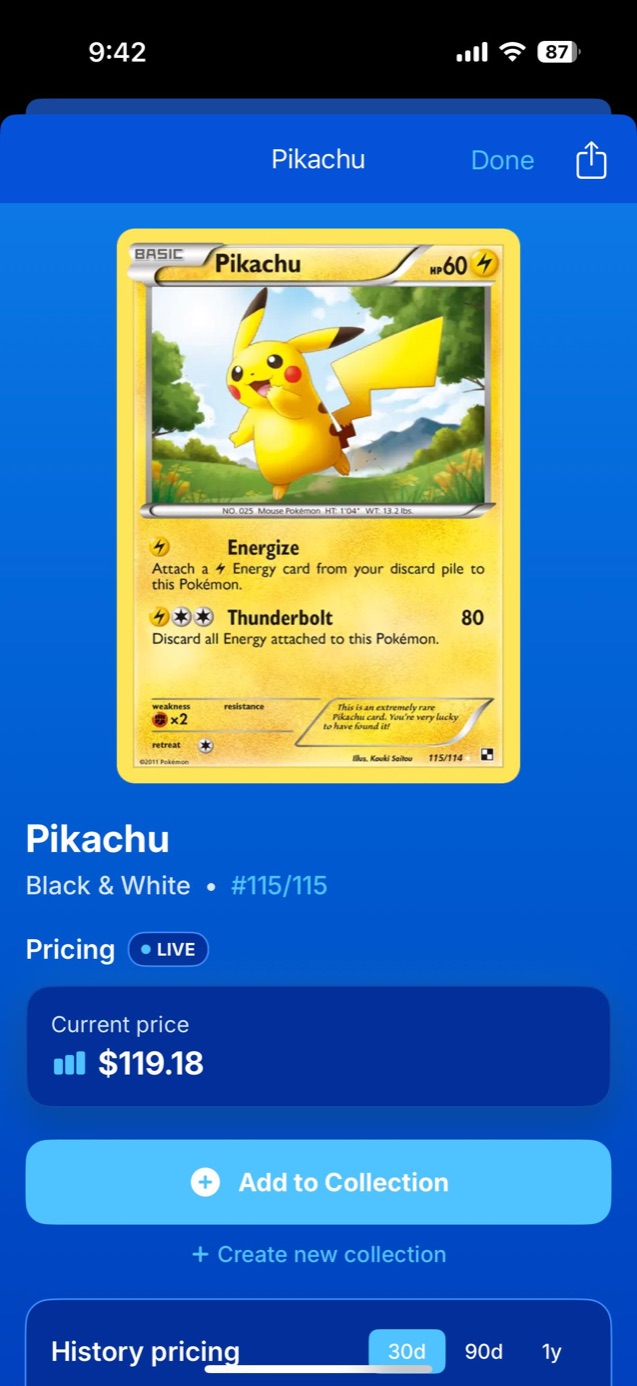
Every modern Pokémon card carries a collector number at the bottom, written as something like 115/114. The first figure is the card, the second is how many cards the set officially contains. When the first number is higher than the second, you are holding a secret rare, which is printed in smaller quantities than the rest of the set.
The set matters more than most people expect. The same Pikachu artwork has been reprinted many times across twenty-five years, and a 1999 Base Set print can be worth hundreds while a recent reprint sells for pocket change. Without the set, a price lookup is guesswork.
Check the finish before you check the price
Tilt the card under a lamp. If the artwork itself shimmers, it is a holo. If the border shimmers while the art stays flat, it is a reverse holo. If nothing shimmers, it is a normal card. These three versions of the same card carry different prices, sometimes by a factor of ten.
Condition then adjusts that figure. Whitening along the edges, surface scratches and off-centre printing all reduce what a buyer will pay. Market listings usually quote Near Mint, so treat that as a ceiling rather than what a played card will fetch.
Compare both marketplaces
TCGPlayer prices reflect the American market and Cardmarket reflects Europe. Exchange rates, regional print runs and local demand pull them apart, and the gap is often wide enough to decide where you should sell.
Look at recent sales rather than asking prices. Anyone can list a card at an optimistic number; only completed sales tell you what buyers actually paid.
Questions
Do I need to get my card graded to know its value?
No. Raw cards have their own market prices, which is what Card Catcher reports. Grading is worth considering only for expensive cards in excellent condition, because the fee has to be smaller than the value it adds.
Why does the same card show two different prices?
TCGPlayer and Cardmarket serve different regions. A card that is common in Europe and scarce in the US will read cheaper on Cardmarket and dearer on TCGPlayer.